


Calming the Overactive Brain: Why Chronic Anxiety Changes Your Brainwaves
- Jul 7
- 2 min read

If you struggle with chronic anxiety, you already know how exhausting it can be. But what if we told you that your anxiety isn't just a character flaw or something "all in your head"? It is a physical pattern your brain has gotten stuck in. At Idaho Counseling & Neurofeedback (ICN), we want you to know that your racing thoughts, disrupted sleep, and physical tension are rooted in tangible, observable changes in your brain's electrical activity.
Serving families across Meridian, Boise, Nampa, and the greater Treasure Valley, we help demystify anxiety by looking at the science behind the stress.
What Does Anxiety Look Like on a Brain Map?
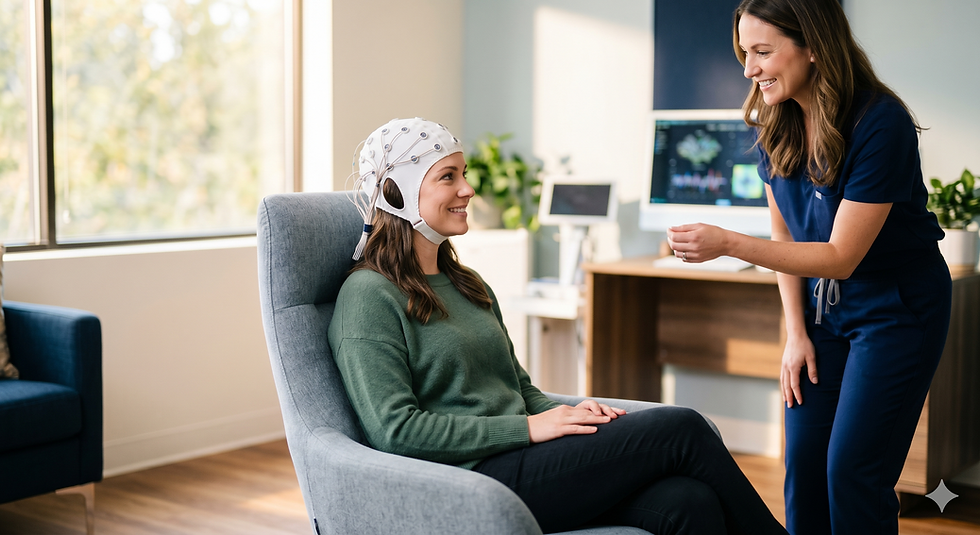
When we perform a qEEG Brain Mapping assessment, we are essentially looking at the "weather report" of your mind. For someone experiencing chronic anxiety, this map often reveals a very specific storm: too many fast beta waves.
Beta waves are the fast-moving brainwaves responsible for active thinking, problem-solving, and alertness. They are incredibly useful when you need to focus on a challenging task or react to immediate danger. However, when your brain produces an excess of these fast beta waves, your nervous system gets locked in a constant state of "fight-or-flight".
Think of it like a car engine stuck idling in high gear. Even when you are parked and trying to rest, the engine is roaring, burning through fuel, and causing unnecessary wear and tear on the vehicle. Your brain is reacting to everyday stressors as if they are life-threatening emergencies.
Switching Out of "Fight-or-Flight"
This is where the power of neuroplasticity comes in. Because anxiety is a learned pattern in the brain, it can be unlearned.
Through Neurofeedback Training, we can help your brain safely practice shifting gears. By providing real-time feedback—like a mirror for your mind—neurofeedback gently trains your nervous system to switch out of "fight-or-flight". It is exactly like building a muscle or tuning an instrument; with consistent training, your brain learns how to produce calmer, more regulated brainwave patterns on its own.
The ICN Difference: Hardware Meets Software
At our clinic, we believe in a holistic approach to healing. While neurofeedback targets the physiological "hardware" of your anxiety (the brainwaves), our empathetic counseling team supports the "software"—the behavioral and emotional patterns. By addressing both the physiology and the psychology, we create a foundation for lasting wellness.
Ready to Find Calm?
You don't have to navigate anxiety alone, and you don't have to accept a nervous system that is stuck in overdrive. If you are ready to map out a personalized plan for your mental wellness, we are here to help.
Reach out to our team at our Meridian office by calling or texting 208-571-2210.


Comments